


List of products by brand SEED2GO GOLD Garden Seeds

Seed2Go Gold Series is a premium brand of mixed varieties for vegetable, bean, pea, peppers, tomatos, and herbs where for every package ordered, 10% of profits are donated to goodwill. 

There are 321 products.

Showing 281-290 of 321 item(s)

Browse catalog by type and build your cart by clicking add to cart. Once clicked and spinner starts, the item is automatically in your shopping cart. When ready to checkout, view your cart and select "Place My Order."


10% of all profits are donated to goodwill projects at our expense.
Lichi Tomato, Red Tomatillo Seeds, South America - [ Shop Canadian Seeds Online ]  - Tomatillo -
  • On sale!
  • New

Lichi Tomato, Red Tomatillo Seeds, South America

Litchi Tomato (Solanum sisymbriifolium) – Description & Uses

Litchi tomato is a unique, spiny plant related to tomatoes and eggplants. It produces small, round fruits that ripen from green to bright red and resemble cherry tomatoes. The plant features deeply lobed leaves covered in sharp thorns, along with attractive white to pale blue flowers with yellow centers. Despite its name, it is not a true tomato but has a similar juicy texture with a slightly tart, cherry-like flavor.

Uses:

Fresh eating: Ripe fruits can be eaten raw; flavor is mildly sweet-tart.

Preserves & jams: Excellent for making jellies or chutneys due to its tangy taste.

Desserts: Can be used in pies or sweet sauces similar to berries.

Ornamental: Grown for its striking flowers and unusual, spiny appearance.

Garden protection: Sometimes used as a trap crop to help manage pests like nematodes.

⚠️ Note: Only fully ripe red fruits are edible—unripe parts and foliage are toxic.

★★★★★ In Stock
Price $4.81
Chiltepin Chili Tepin Pepper, Chile Tepin, Chiltepin, Chiltepine, Mexican Pepper, Hot Pepper - [ Seed2Go.ca ] - [Seed Packets] -
  • On sale!

Chiltepin Chili Tepin Pepper, Chile Tepin, Chiltepin, Chiltepine, Mexican Pepper, Hot Pepper

These round to oval fruits are only 3/8” wide. It is often confused with the Pequin that is a small oval with a point. The Tepin grow on 36” tall plants and have extreme heat. All peppers are perennials, so if your plant survives the winter without freezing, the shrub can get very large. Capsicum annuum  (120 days)

Heat Level: Super Hot.  Scoville Heat Units 50,000 - 100,000

~ Packet contains 10 seeds. 

In early spring, start seeds indoors 8 weeks prior to warm nightly temperatures. Place the seeds in sterile media and cover 1/4” deep. Provide 85°F bottom heat, bright light and keep moist at all times. Seeds will germinate in 7 - 21 days. Transplant seedlings into pots and grow until there are 6 true leaves on the plant. Plant them directly into rich soil, 30” apart or into large 5 gallon containers. Harvest peppers when they are red.

★★★★★ In Stock
Price $4.81

Winged Pole Bean, Oriental Bean Seeds, 四角豆 Sì Jiǎo Dòu

Winged beans are a tropical legume where the entire plant is edible: the pods have four "wings," the leaves can be cooked like spinach, and the roots form a tuber similar to a potato. They are a nutritious food source, rich in protein, vitamins A and C, and iron, and are a staple in many Southeast Asian cuisines. 

Growth: They are a vining plant that requires sturdy support, like a trellis, to grow.

Pods: The pods are angular with four frilly "wings" running lengthwise, and they can be green, purple, or red.

Edible parts: You can eat the pods when young, and the mature seeds can be used like soybeans.

Other edible parts: The leaves taste like spinach, the flowers can be eaten, and the roots can be cooked like a potato or sweet potato. 

Pods: Young pods can be eaten raw in salads or sliced and stir-fried.

Seeds: Mature seeds can be dried and ground into flour or used similarly to soybeans.

Roots: The tuberous roots are edible cooked or raw and have a nutty flavor.

Leaves: Young leaves are tender and can be cooked like spinach. 

Climate: They thrive in hot, humid conditions but can also be grown in temperate zones.

Planting: Seeds are frost-sensitive and should be planted after the last frost. Cooler soil temperatures can hinder germination.

Preparation: Before planting, seeds benefit from being soaked for 12–24 hours and may require gentle nicking to help with germination. 

Type Bean/Pea
Family Legume Family
Temperature Soil 60F
Temperature Daytime 70-85F
Temperature Evening 60F+
Lighting Full, 6-8 Hours Per Day
Water Steady: 6 Gallons / Week
Maturity Moderate: 55-70 Days Harvest
PH Neutral 5.5-7.5
Zones 3A-11B
Plant Placement 16 Plants, 8 Per Row


★★★★★ In Stock
Price $4.81
Red Jamaican Hot Pepper, Jamaica, Scotch Bonnet Type  Pepper Seeds - [ Shop Canadian Seeds Online ]  - Pepper Seeds -
  • On sale!

Red Jamaican Hot Pepper, Jamaica, Scotch Bonnet Type Pepper Seeds

Scoville Units: 100.000 ~ 200.000

The Jamaican Hot Red is a compact plant which will grow to 60 cm in height. The plant gets an abundance of peppers. They are similar to Scotch Bonnet peppers and the pods are 5 cm long and 3.5 cm wide and look like mushrooms. They color during ripening from green to red and are very hot. The peppers have a fruity flavor and are widely used in the Caribbean for making hot sauces.

Species: Capsicum Chinense

Type Peppers
Family Nightshade Family
Temperature Soil 65-80F
Temperature Daytime 70-90F
Temperature Evening 60+F
Lighting Full Sun, 6-8 Hours/Day
Water Heavy, 6 Gallons/Day
Maturity Moderate, 65-85 Days Harvest
PH Neutral 5.5-7.0
Zones 4A-11B
Plant Placement 6 Plants, 3  Row
★★★★★ In Stock
Price $4.81

Shar-Pei Zou-Pi Wrinkled Pepper, Hot Pepper Seeds, Southern Chinese Pepper

Wrinkled Pepper is a specific variety of hybrid hot chili pepper (Capsicum annuum) known for its high pungency and wrinkled appearance. It is a strong-growing, high-yield plant primarily used in Chinese and other Asian cuisines. 

Heat Level: It is a hot pepper with high pungency.

Appearance: The fruits are long and have a distinctive wrinkled skin. They ripen from green to a vibrant red color.

Fruit Size: Individual fruits are relatively large for a hot pepper, typically around 13-16 cm (about 5-6 inches) in length and 3.0-3.5 cm (about 1.2-1.4 inches) in diameter.

Maturity: It is an early-maturing variety, generally ready for harvest around 55 days after transplanting.

Plant Habit: The plant has strong vigor and a semi-upright growing habit, making it prolific and high-yielding.

Usage: It is suitable for both fresh markets and for drying to create chili flakes or powder. 

Type Peppers
Family Nightshade Family
Temperature Soil 65-80F
Temperature Daytime 70-90F
Temperature Evening 60+F
Lighting Full Sun, 6-8 Hours/Day
Water Heavy, 6 Gallons/Day
Maturity Moderate, 65-85 Days Harvest
PH Neutral 5.5-7.0
Zones 4A-11B
Plant Placement 6 Plants, 3  Row
★★★★★ In Stock
Price $4.81

Thai Hot Pepper, Thailand, Birds Eye Pepper, Bird Chili Pepper Seeds

Thai hot peppers, also known as bird's eye chilies, are small, fiery peppers that measure between 50,000 and 100,000 Scoville heat units, making them significantly hotter than a jalapeño but milder than a habanero. These peppers have a slender, tapered shape, are about 1–2 inches long, and mature from green to a bright red color. They have a fruity, earthy flavor with a pungent heat that is used widely in Thai and other Southeast Asian cuisines, often in curries, soups, and stir-fries. 

Size and shape: Small, slender, and tapered, usually 1–2 inches long and 1/4–1/2 inch wide.

Color: Green when young, ripening to a bright red.

Flavor: Fruity and earthy, with a pungent heat.

Texture: Thin, crisp, and waxy when fresh. 

Scoville units: 50,000–100,000 SHU.

Comparison: About 23 times hotter than a jalapeño and roughly one-third as hot as a habanero.

Note: The seeds and membranes contain the most heat and can be removed to reduce it. 

Thai Chili

Thai chili, also known as bird's eye chili or simply bird chili, is a small, fiery pepper variety native to Southeast Asia. 

Type Peppers
Family Nightshade Family
Temperature Soil 65-80F
Temperature Daytime 70-90F
Temperature Evening 60+F
Lighting Full Sun, 6-8 Hours/Day
Water Heavy, 6 Gallons/Day
Maturity Moderate, 65-85 Days Harvest
PH Neutral 5.5-7.0
Zones 4A-11B
Plant Placement 6 Plants, 3  Row
★★★★★ In Stock
Price $4.81

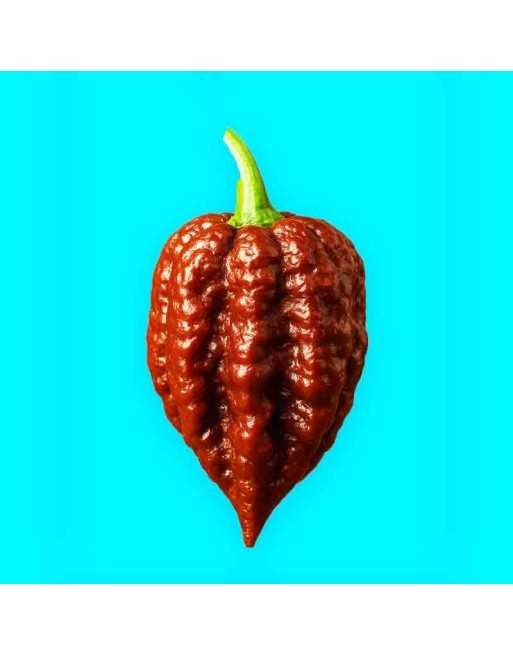
Chocolate Naga Brain Pepper, Hybrid, Brain Strain 7 & Dorset Naga, Pepper Seeds

Chocolate 7 Pot Brain Strain pepper plants are high yielding plants that grow to be about three to four feet tall and average about 1,000,000 to 1,350,000 Scoville Heat Units (SHU).
Fruity flavor
Start off green, ripen to brown.
A rare and intensely hot chili, the Chocolate Naga Brain Pepper is known for its deep chocolate-brown color and extremely wrinkled, “brain-like” surface. The pods are small to medium-sized with a slightly pointed tail, and they mature from green to a rich brown. It delivers a strong fruity aroma with smoky, earthy undertones—followed by an immediate and aggressive heat.
(Comparable to other superhot varieties like Naga and Ghost-type peppers)
Ideal for ultra-hot sauces and chili extracts
Adds depth to BBQ sauces, marinades, and salsas
Can be dried and ground into potent chili powder
Used sparingly in spicy cooking for extreme heat lovers
⚠️ Handle with care—use gloves when cutting, as the oils are extremely potent.
Type Peppers
Family Nightshade Family
Temperature Soil 65-80F
Temperature Daytime 70-90F
Temperature Evening 60+F
Lighting Full Sun, 6-8 Hours/Day
Water Heavy, 6 Gallons/Day
Maturity Moderate, 65-85 Days Harvest
PH Neutral 5.5-7.0
Zones 4A-11B
Plant Placement 6 Plants, 3  Row
 
★★★★★ In Stock
Price $4.81
Toma Super Verde Tomatillo Seeds, Little Tomato, Mexican, Green Salsa - [ Seed2Go.ca ] - [Seed Packets] - Tomatillo -
  • On sale!

Toma Super Verde Tomatillo Seeds, Little Tomato, Mexican, Green Salsa

Verde is an early variety with tart flavor when young, becoming sweeter as it ripens. Harvest in 85 days. Tomatillo Verde produces large juicy fruits that weigh 3-4 oz. Determinate plants grow 24" tall. Grow two plants to ensure fruit set because two or more tomatillo plants are required for the plants to blossom. 

Plant seeds 1/4" deep then thin to 24" apart. It is best to start seeds indoors.

Medium to large size fruits are ready to harvest when husks split and fruit color changes from a yellow green to medium green. Perfect for Salsa Verde or as a special addition to any Mexican dish.

Tomatillo seeds can be started indoors.

Tomatillos are an ingredient often present in Mexican dishes, and the fruit is grown similarly to a tomato.

Sow seeds 2-3 weeks before the last frost date and transplant when soil is warm.

Plant seeds 1/4" deep and 3" apart. Seeds should come up in 14-21 days. 

Thin plants to 24" apart after germination.

Each packet contains 50 Organic Tomatillo Verde seeds. Physalis philadelphica. Annual. Open-pollinated, heirloom, non-GMO. Harvest in 85 days.

★★★★★ In Stock
Price $4.81

Mignonette Alpine Strawberry Seeds

Type Strawberry
Family Rose Family
Temperature Soil 60-65
Temperature Daytime 45-85F
Temperature Evening 35F
Lighting Light, Full, 6-8 Hours/Day
Water Up to 6 Gallons/Week
Maturity Long, Perennial
PH Neutral 5.8-6.5
Zones 3A-10B
Plant Placement 3 Plants, 3 Rows
★★★★★ In Stock
Price $4.81

Blueberry Fruit, Low Bush Type, Native, Blueberry Seeds

Vaccinium angustifolium

Stratification: Cold stratify 90 days or sow outdoors in late fall or winter. Mix with vermiculite or perlite or moss and place in plastic bag and fridge for 6 weeks. Sow seed at soil tops, do not let seed dry out.

Blueberries produce clusters of small urn-shaped flowers that range in colour from white to pale pink. The fruits are true berries with many small seeds and are a deep indigo to black colour when ripe.

Size: Lowbush blueberries can grow up to two feet tall and wide. 

Leaves: Lowbush blueberry leaves are short-stalked, elliptic, and have finely serrated edges. The upper surface is pale to dark green, while the lower surface is lighter green. 

Flowers: In the spring, lowbush blueberries produce small, white, or pink bell-shaped flowers. 

Berries: Lowbush blueberries produce small, juicy, blue berries in the summer. The berries are rich in vitamin C and sugars. 

Fall color: In the fall, lowbush blueberry leaves turn bronze, scarlet, and crimson. 

Winter color: In the winter, lowbush blueberry twigs turn yellow-green to reddish. 

Habitat 

Lowbush blueberries grow in open conifer woods, sandy or rocky balds, and old fields.

They prefer full sun to partial shade and acidic, moist to dry soils.

Uses 

Lowbush blueberries are often used in jams and jellies.

They are also eaten by wildlife, such as bears.

Lowbush blueberries are occasionally used to revegetate disturbed sites.

★★★★★ In Stock
Price $4.81